It’s nearly summer. The temperature outside is pushing 95 degrees. You get home, walk through the door, and it’s just as hot inside as it is outside. Your AC gave out. No warning. No gradual slowdown. Just done.
You call an HVAC company. They’re booked out for two days. When they finally show up, the diagnosis isn’t good. A part failed, wore down over months, and nobody caught it in time. The repair bill? Painful.
This is not a rare story. It happens to thousands of homeowners every summer. And in most cases, a scheduled AC inspection would have caught the problem long before it became a crisis.
What the Numbers Actually Tell Us
Let’s start with some context. The U.S. Energy Information Administration reports that air conditioning accounts for about 12% of total U.S. home energy expenditures, and that number climbs steeply in warmer regions like the South and Southwest.
When an AC system is running with dirty coils, low refrigerant, or clogged filters, it works harder to produce the same amount of cooling. Studies from ENERGY STAR show that neglected systems can waste up to 30% more energy than properly maintained ones. On a $200 monthly utility bill, that’s $60 gone every single month for no reason.
Beyond energy, consider replacement costs. A new central AC system runs between $3,500 and $7,500 installed, depending on the unit and home size. Regular maintenance can extend a unit’s life by 5 years or more. A yearly inspection averaging $100 costs you $500 over five years. Delaying a $5,000+ replacement? That math is hard to beat.
What Could Be Going Wrong Inside Your AC Right Now
Here’s what makes an AC inspection genuinely worthwhile: most of the things that cause system failures are invisible to you. You can’t see low refrigerant. You won’t notice a slightly bent condenser fin or a slowly loosening electrical connection until something stops working.
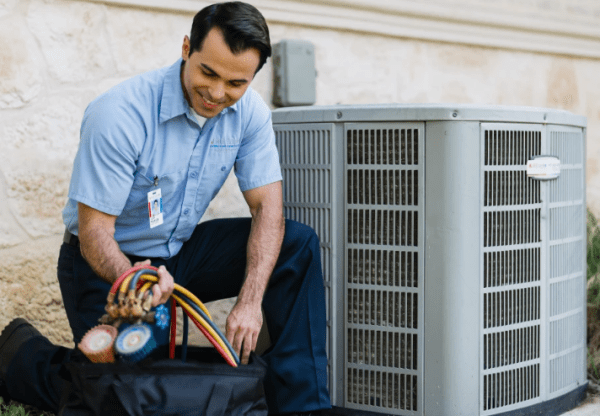
A licensed HVAC technician goes through a checklist that covers every part of your system, including:
Refrigerant charge: Too little refrigerant means your system strains to cool, uses more power, and risks compressor damage.
Electrical components: Loose wiring is both a performance issue and a fire hazard. Capacitors and contactors wear out and need periodic replacement.
Coil cleanliness: Both evaporator and condenser coils collect dirt over time. Dirty coils reduce efficiency and can cause the system to freeze up.
Blower motor and fan blades: Dust buildup and worn bearings put extra stress on the motor, shortening its lifespan.
Condensate drain: A clogged drain line backs up moisture into your home, leading to water damage and mold.
Thermostat accuracy: A miscalibrated thermostat causes your system to run longer than needed or shut off too soon.
Each of these issues, caught early, costs relatively little to address. Left alone, any one of them can snowball into a major repair.
Air Quality Is Part of the Story Too
This piece often gets overlooked. Your AC doesn’t just cool air; it circulates it. A neglected system with a clogged filter or a moldy drain pan pushes that air, and everything in it, through every room in your house.
The EPA has noted that indoor air can be two to five times more polluted than outdoor air, and a poorly maintained HVAC system is one of the contributing factors. For anyone in the house dealing with allergies, asthma, or respiratory sensitivities, this matters a lot.
An AC inspection includes checking airflow, filter condition, and drainage components, all of which directly affect the air your family breathes daily.
Don’t Forget What Your HVAC Warranty Requires
A detail buried in most AC warranty documents: manufacturers typically require proof of annual professional maintenance. If your unit breaks down and you file a warranty claim without that documentation, the claim can be denied outright.
That means you could own a unit that’s technically still under warranty and still end up paying full price for a repair because no one serviced it on schedule. One inspection a year keeps that protection intact.
How to Get the Most Out of Your AC Inspection
Timing matters. Spring is the best window, before the heat builds and before HVAC companies are slammed with emergency calls. You’ll get better availability, potentially better pricing, and your system will be ready when you actually need it.
A few things to do before the technician arrives:
Replace your air filter if it’s been more than 90 days since the last change.
Clear any debris, leaves, or overgrowth from around the outdoor condenser unit.
Note any issues you’ve observed, unusual sounds, warm spots in the house, or higher bills, and mention them at the start of the visit.
After the inspection, ask for a written summary. Any reputable HVAC company will provide one. That document is your maintenance record, and it’s worth keeping on file.
Signs You Shouldn’t Wait for the Annual Visit
Annual inspections are the baseline. But some situations call for a faster response. Get your system checked sooner if you notice:
Ice forming on the refrigerant lines or indoor unit
The system running constantly without reaching the set temperature
A significant unexplained jump in your electricity bill
Humidity inside the house that feels noticeably higher than usual
Any burning smell when the system kicks on
These aren’t things to monitor and see how they go; they’re signs something is already wrong.
One Small Habit, One Big Difference
There’s no complicated strategy here. Schedule an AC inspection once a year. That’s it. It takes a couple of hours, costs less than a nice dinner out, and protects a system you rely on for months of the year.
The homeowners who avoid expensive surprises aren’t lucky. They’re just consistent. They treat their AC like the major appliance it is, not like a box in the wall that runs until it doesn’t. Get ahead of it this season. One call now is a lot better than an emergency in August.

 It’s nearly summer. The temperature outside is pushing 95 degrees. You get home, walk through the door, and it’s just as hot inside as it is outside. Your AC gave out. No warning. No gradual slowdown. Just done.