Renting an apartment might give you flexibility, but in most states in the US, renting is actually more expensive than owning a home.
According to this map from personal finance site HowMuch, renting a home is, on average, more expensive long term than owning a home in 40 out of 50 states in the US. The few outlier states where renting is cheaper than buying are concentrated in the west (but Washington DC and Vermont also sneak in there). If the difference between renting and owning is less than $50 a month, then states are classified as “Neutral”:
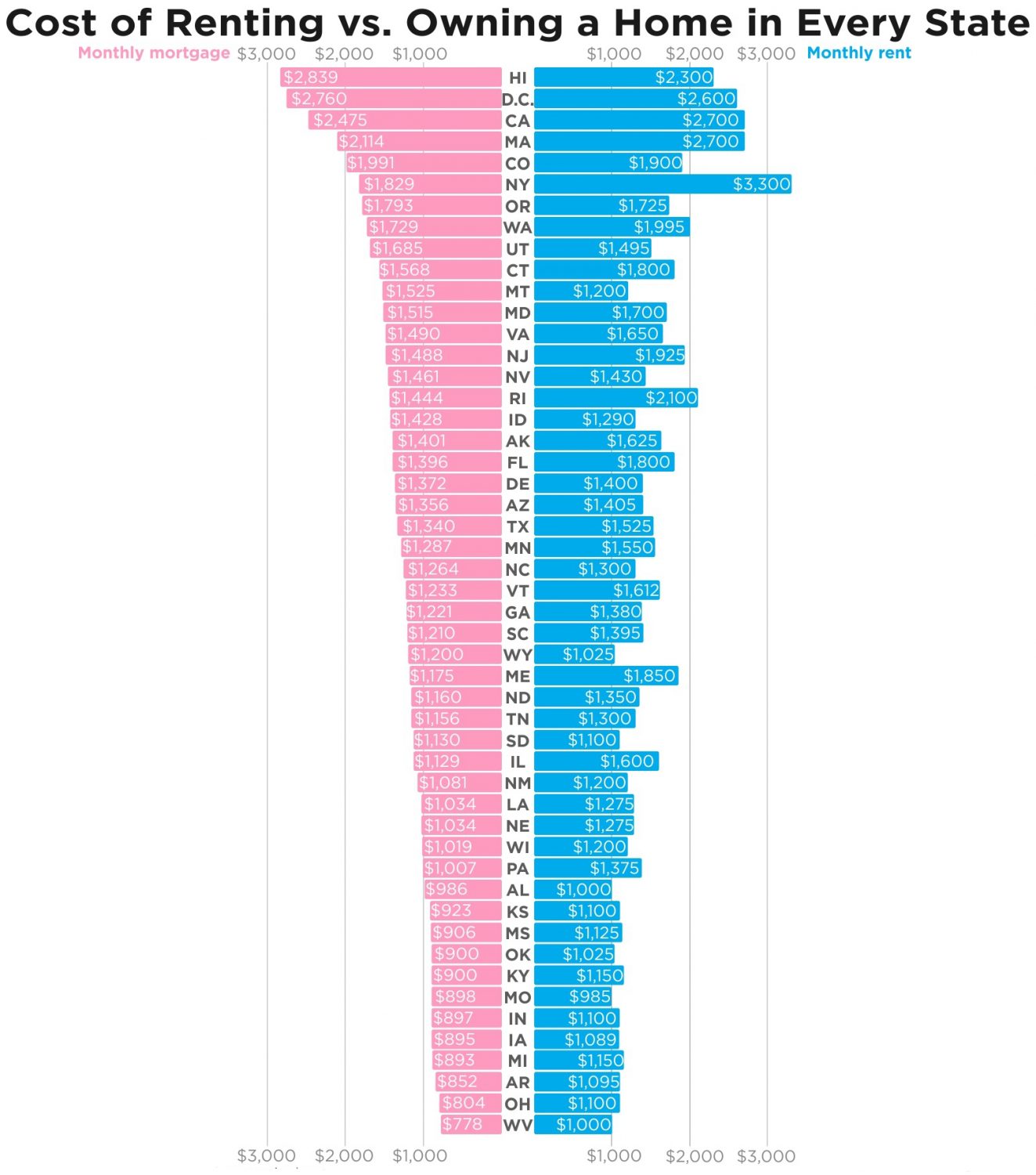
Using data from GoBankingRates, HowMuch also compiled a chart that shows the costs of renting vs. owning a home in each state in the US. Surprisingly, the cost of living is extremely high in Hawaii, with the monthly mortgage for homeowners averaging $2,839 a month. That’s more than three times as much as the average mortgage of homeowners in West Virginia, one of the states with the lowest living costs in the country.
Buying a home is a big financial investment – perhaps the biggest one you’ll make in your life. Be sure to do your homework and carefully evaluate how you want to live and how much you can comfortably afford.
Homeownership can be very rewarding if you are properly prepared, know what to expect, and make informed financial decisions.
Is buying a home right for you? It may make sense if you:
Have reliable income, good credit, and documentation to verify your savings.
Want a chance to build equity and be eligible for homeowner tax breaks and credits.
Have the time and money required for home maintenance and improvement projects.
Have an adequate cash reserve to withstand a loss of job, illness, or other financial setback.
Are planning on staying in your home for at least five years.
Rent vs. Buy: Crunching the Numbers
The costs of renting or buying are varied, making it hard to tell which makes better financial sense. You can use Freddie Mac’s Rent vs. Buy calculator to evaluate the costs as illustrated for Sally and Darren in the example below.
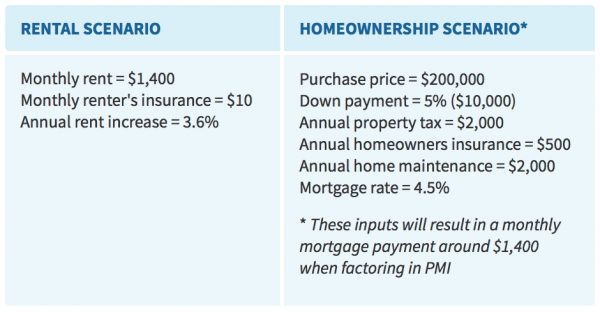
Sally and Darren want to know if it makes better financial sense to rent or buy given their current $1,400 rent payment. How much home can they buy knowing they can afford a $1,400 monthly mortgage payment and can make a 5% down payment?
THE SCENARIOS
We’ve also put in other assumptions and costs for Sally and Darren, including: a 3% home appreciation rate, a $1,500 origination charge, $1,000 for settlement services, 3% for selling costs, a 33.8% state and federal tax rate, and a savings rate of zero.
The Outcome
With this scenario, Sally and Darren will save $92,216 by buying instead of renting over a seven year period. If they stay in their home for 15 years, they will save $273,558. Over 30 years, they’ll save $887,450.
Armed with this knowledge, Sally and Darren are better prepared to answer the rent vs. buy question.
KEY TAKEAWAYS
Homeownership is a long-term financial commitment
Comparing the financial differences between renting and buying is complex. You can use Freddie Mac’s calculator to determine this.
Long-term, Sally and Darren would benefit financially from homeownership